PLAYS
- A Midsummer Night’s Dream (Folger Shakespeare edition)*
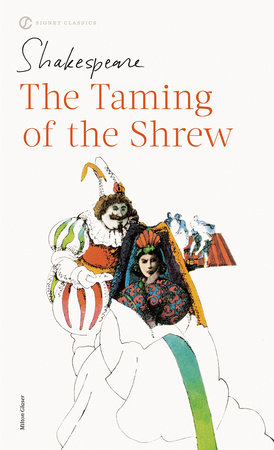
- The Taming of the Shrew (Folger Shakespeare edition)*
- Hamlet (Folger Shakespeare edition)*
READINGS ABOUT SHAKESPEARE AND THE FOLKTALE
- Artese, Charlotte. Shakespeare and the Folktale: An Anthology of Stories. Princeton University Press, 2019.*
- “The Most Obedient Wife” (Denmark).
Grundtvig, Svend. Danish Fairy Tales. Translated by Gustav Hein. George G. Harrap, 1914. 175–83. - “How a Bad Daughter Was Made a Good Wife” (Scotland).
MacLellan, Angus. Stories from South Uist. Translated by John Lorne Campbell. Routledge and Kegan Paul, 1961. 65–69. - “The Frolicksome Duke, or the Tinker’s Good Fortune” (England).
English Broadside Ballad Archive, University of California Santa Barbara, edited by Patricia Fumerton. http://ebba.english.ucsb.edu/ballad/21895/xml - “The Queen and the Tripe-seller” (Italy).
Busk, Rachel Harriette. The Folk-lore of Rome. Longmans, Green, 1874. 348–54. - “Fairies.”
Briggs, Katharine. British Folktales. Pantheon, 1977. 151–67. - Sigmund Freud, Letter to Wilhelm Fliess, Oct. 15, 1897.
Freud, Sigmund. The Origins of Psychoanalysis: Letters, Drafts and Notes to Wilhelm
Fliess, 1887–1902. Doubleday, 1954. 226–27. - Edmunds, Lowell. Oedipus: The Ancient Legend and Its Later Analogues. Johns Hopkins University Press, 1985.
- “Jean” (Egyptian Christian), 73–79.
- “Pope Gregory” (Medieval Latin), 79–88.
- “The Rabbi and His Son” (Israeli), 199–205.
- Uther, Hans-Jörg. The Types of International Folktale: A Classification and Bibliography. 3 vols. Folklore Fellows. 2004.
“The Prophecy”
READINGS ABOUT DIGITAL HUMANITIES AND DIGITAL STORYTELLING
- Alexander, Bryan. The New Digital Storytelling: Creating Narratives with New Media. 2nd ed. Praeger, 2017.
- Lambert, Joe. The Digital Storytelling Cookbook. Digital Diner Press, 2010. Chapters 1–3.
https://www.storycenter.org/inventory/digital-storytelling-cookbook - Larsen, Mary. “‘We All Begin with a Story’: Discovery and Discourse in the Digital Realm.” In Oral History and Digital Humanities: Voice, Access, and Engagement, edited by Douglas A. Boyd and Mary Larsen. Palgrave Macmillan, 2014.
- Robin, Bernard. “Digital Storytelling: A Powerful Technology Tool for the 21st Century Classroom.” Theory into Practice 47, no. 3 (2008): 220–28.
- Schneider, William. “Oral History in the Age of Digital Possibilities.” In Oral History and Digital Humanities: Voice, Access, and Engagement, edited by Douglas A. Boyd and Mary Larsen. Palgrave Macmillan, 2014.
- Steelman, Sheridan. “‘Whose Ghost Is It Anyway?’ Teaching Shakespeare Using Primary Documents.” English Journal 108, no. 2 (2018): 39–47.
READINGS ABOUT VISUAL RHETORIC
- Bang, Molly. Picture This: How Pictures Work. Chronicle Books, 2016.*
*Participants will receive copies of these texts in April 2026.